Telehandler Load Charts Explained: Angles, Extension, and Capacity
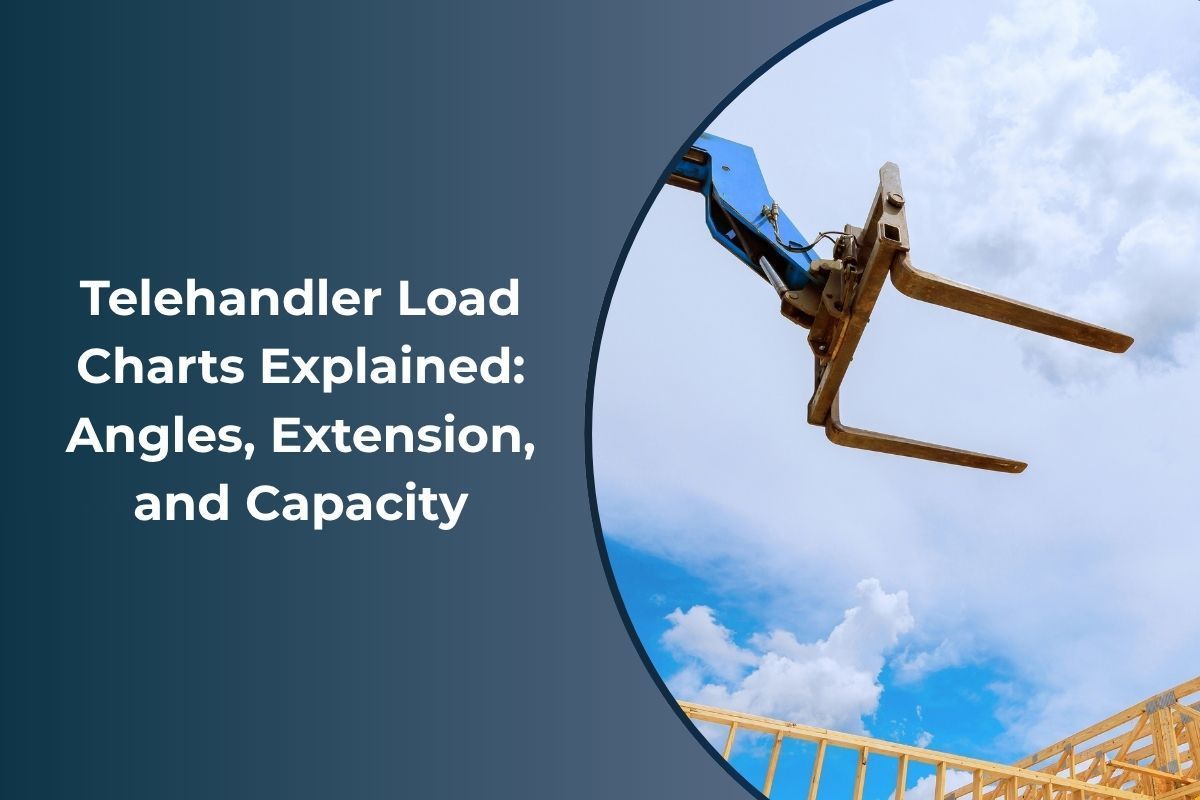
A telehandler load chart shows the maximum weight the machine can safely lift at every combination of boom angle and extension length. Reading it wrong is how loads tip, forks bend, and job sites shut down for the afternoon.
This guide covers what a load chart shows, how to read one, how attachments and load centers affect the numbers, and the mistakes that most often catch Edmonton contractors.
Quick Answer: How Do You Read a Telehandler Load Chart?
Find the boom angle on one axis, extension length on the other, and the intersection gives the maximum safe load at that position.
The catch: every telehandler has its own chart, every attachment has its own chart within the machine, and the chart assumes level ground with standard load center. Miss any of those and the number lies to you.
What a Telehandler Load Chart Shows
A load chart is a grid. Along one axis is the boom angle, usually 0 to 70 degrees. Along the other is boom extension, from retracted to full reach. Each cell gives the maximum load the machine can lift at that exact position.
The numbers are not linear. Capacity drops fast as the boom extends and lowers. A telehandler that lifts 10,000 lbs at a 70 degree boom angle with the boom retracted might only lift 1,000 lbs at 20 degrees fully extended. That drop is not a safety cushion. It's the tipping threshold.
Charts also change based on whether the machine is on wheels or on outriggers. If your telehandler has stabilizers, there will be a separate chart for stabilizers deployed.
How to Read a Load Chart Step by Step
Confirm the chart matches the machine and attachment
A JLG 1055 chart does not apply to a JLG 1255. Forks, buckets, jibs, and truss booms each have their own chart.
Read your boom angle
The angle indicator is on the boom itself or on the operator screen. Note it before you start the lift, not during.
Read your extension length
Shown on the boom in feet marks or on the cab display. Newer JLG and Genie units display it digitally.
Cross-reference the two
Find the angle on one axis, extension on the other, read the intersecting cell. That's your maximum safe load for that exact position.
Compare to the actual load
Weigh it or confirm the weight from the delivery slip. If the load exceeds the chart value anywhere in the lift path, the lift cannot be performed safely with that machine.
Sample Load Chart Layout
Below is a simplified layout modeled on a JLG 1055-style telehandler. Real charts are denser and include stabilizer zones and off-center load ranges, but the pattern is the same.
| Boom Angle | Retracted (0 ft) | Mid (25 ft) | Full Extension (55 ft) |
|---|---|---|---|
| 70° | 10,000 lbs | 8,000 lbs | 4,500 lbs |
| 50° | 10,000 lbs | 6,000 lbs | 2,500 lbs |
| 30° | 10,000 lbs | 3,500 lbs | 1,200 lbs |
| 10° | 8,000 lbs | 2,000 lbs | Outside safe envelope |
Capacity is highest with the boom vertical and retracted. It drops sharply as the boom lowers and extends. Every telehandler in the Mandel telehandler fleet follows this pattern with different specific numbers.
Load Center and Why It Matters
Load center is measured from the face of the forks to the center of gravity. Every chart is rated at a fixed load center, usually 24 inches. Longer loads shift the center, and capacity drops the moment you push past the rated distance.
A telehandler rated for 8,000 lbs at a 24-inch load center might only handle 5,000 lbs of a 20-foot lumber bundle safely.
Rule of thumb: if the load extends more than a foot past the tip of the forks, pull the chart for extended load centers or drop your working capacity by 30 to 40 percent as a starting point and verify.
How Attachments Change the Chart
Every attachment has its own weight and its own load center. The chart in the cab reflects standard forks. Swap attachments and you need a different chart.
Forks
Standard chart applies. Load center rated at 24 inches from the fork face.
Bucket
Load center pushed out from the machine, capacity reduced across the range.
Truss boom or jib
Significant capacity reduction. These attachments extend reach past the boom itself, which multiplies the load moment.
Work platform
Capacity is limited by the platform rating, not the machine rating. Personnel lifting with a telehandler is a separate certification and a separate chart entirely.
If you're renting with attachments, confirm the chart for each. More detail is in the telehandler attachments guide.
Common Load Chart Mistakes on Edmonton Job Sites
Assuming rated capacity is always available
The spec sheet number is peak lifting capacity, reached in one boom position. Most working lifts happen at reduced capacity.
Not accounting for slope
Charts assume level ground. On a graded site or soft spring surface, real capacity is lower than the chart shows. The telehandler safety checklist covers ground assessment in detail.
Ignoring wind
Prairie wind past 25 km/h changes the safe working envelope, especially at reach. A 4,000 lb bundle of insulation catches wind like a sail.
Guessing the weight
Estimating a pallet is how loads tip. If the weight isn't on the slip, ask. Load center matters, but only if the weight is right in the first place.
Frequently Asked Questions
What happens if you exceed a telehandler load chart?
The machine tips forward or sideways depending on boom position. Modern telehandlers have load moment indicators that alarm before tipping, but they're a warning system, not a safety net. Once the load moment is exceeded, physics wins.
Where is the load chart located on a telehandler?
Typically inside the cab, usually on the door pillar or above the operator's head. Newer machines display it digitally on the operator screen.
Do you need to be certified to read a load chart?
Load chart use is part of standard telehandler operator training under CSA B335 in Canada. Certification is required to operate the machine, and load chart literacy is part of that training.
Does wind speed affect the load chart?
Yes. Most manufacturers rate charts up to 12.5 m/s (about 45 km/h) wind speed. Beyond that, lifting operations should stop. Loads with large surface area (drywall, insulation, sheet goods) become unsafe well before that threshold.
Ready to Book a Telehandler?
If you know the load weight, the reach you need, and the working boom angle, matching a telehandler to the job is straightforward.
The Mandel telehandler fleet covers the range from the Genie GTH-1056 up to the JLG 1255.
If you're still narrowing down, the choosing the right telehandler guide walks through it, or call 780-699-9433 and we'll help match the machine to the lift.
Mandel Rentals Resources